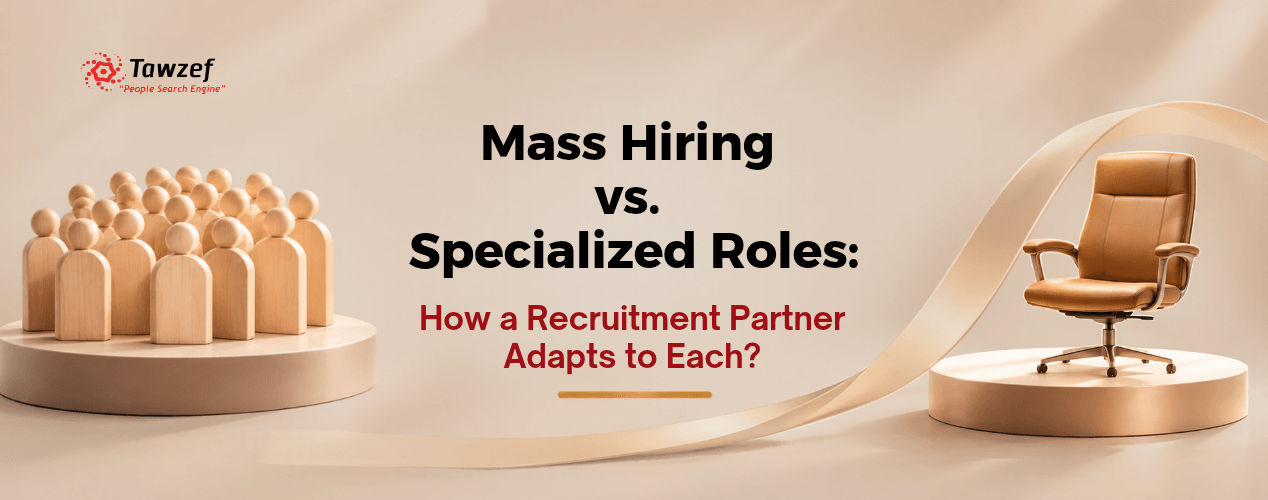


Companies often treat recruitment for different types of roles and different modes, like mass recruitment, the same way. Publish a generic job description across multiple sites, get hundreds, sometimes thousands, of applications, and screen them all.
The process easily takes them months before they can find the candidates they need and before they can get into the interviewing stages and negotiations.
This is not a feasible way of finding talent. More importantly, mass recruitment doesn’t operate the same way you would when searching for specialized talent or roles, or even with executive search. The process and methods are different.
For one, mass hiring means filling a larger number of similar roles in a compressed time frame.
In this article, we’ll walk you through the top differences between mass hiring and specialized recruitment and how methodology differs across hiring steps. We’ll also cover the tentative length of each method and how a recruitment partner can support your needs across each recruitment model.
What's the Difference Between Mass Hiring and Specialized Recruitment?
Mass hiring, also known as bulk recruitment, is built for volume. Repeatable roles, fixed criteria, and candidates processed in parallel instead of one at a time.
Meanwhile, specialized recruitment and executive search are built for precision. These are the senior and hard-to-fill roles where the qualified pool is small and the right person usually isn't applying to anything. They often require a specialized talent acquisition strategy or expert headhunting.
Mass Recruitment vs Specialized Hiring: The Trigger
Mass hiring starts with an operational event. A new site or branch opening, a project mobilization, a seasonal peak, or a contract that needs 300 people on the ground by a fixed date.
Specialized hiring starts with a gap. A leader resigns, a new function needs building, or a role sits vacant because there’s no internal talent to step in and fill it.
Who you're competing for
Mass recruitment targets active job seekers. They're applying, available, and comparing offers in real time.
Specialized recruitment targets people who aren't looking. They're employed, performing well, and need a reason to take your call and consider your offer.
It’s a gap in candidate mindset, and it drives almost every other difference in the two models.
Mass vs specialized: How the funnel is shaped
Mass hiring runs a wide funnel. Thousands in at the top, structured filters throughout, and a high-throughput process designed to move people forward quickly.
Specialized hiring runs a narrow one. You might approach 40 people to build a shortlist of five.
The volume side is a big problem. And many companies that suddenly have to turn to bulk hiring underestimate what it involves.
In addition, in 2025, the average number of applicants per vacancy across the GCC rose 80.3% to reach 321 candidates.
What happens when things go wrong?
Underfill a bulk campaign, and the site opens short-staffed. The damage is immediate, visible, and measured in operational delay.
Mis-hire a senior role, and the damage intensifies over the coming months and quarters.
In the United States, SHRM's 2025 benchmarking data puts median cost-per-hire at $1,200 for non-executive roles and $10,625 for executive ones, a ratio of nearly nine to one. The replacement cost is only part of it.
One screening template can't serve both.
Sourcing: Bulk Campaigns vs Direct Approach
Mass hiring sources through campaigns, including multiple job boards, social media ads, referral campaigns, open days, and on-ground hiring events. The goal is expanded reach.
For successful mass recruitment, you need a good bulk recruitment strategy. This helps you build pre-vetted talent pools ahead of demand, so the next campaign starts with candidates already in hand.
On the other hand, specialized recruitment sources use a direct approach. The recruiter maps the market, identifies who's doing the job well at competitors, and reaches out one conversation at a time.
Depending on the role, there might be a job advertisement. However, with senior and confidential roles, no role is announced. Companies tap talent directly, and nobody outside the search even knows the role exists.
This matters more as talent gets scarcer. Some 88% of GCC organizations reported skill shortages in 2025.
For cross-border bulk hiring, sourcing also runs through licensed agents and manpower supply networks in the sending country.
Screening: Batch Processing vs Structured Assessment
When hiring en masse, you need to screen and interview in batches.
Mass recruitment screens in batches. Knockout questions filter the obvious misses, then CV screening runs against a fixed scorecard rather than a recruiter's judgment call.
Trade tests do the heavy lifting for technical roles. A welder either passes the weld test or doesn't, which makes the decision fast and defensible at scale.
Group assessments, medical checks, and document verification handle the rest.
Meanwhile, specialized recruitment screens one candidate at a time. Structured interviews against defined competencies, case exercises or presentations for senior roles, and reference and background checks that go beyond confirming dates of employment.
Psychometric assessments add a layer that interviews can't reach, covering working style, decision-making under pressure, and how someone operates in a team.
How Long Does Each Hiring Model Take?
There’s no straightforward answer.
SHRM’s 2025 benchmarking data puts median time-to-fill at 44 days for non-executive roles and 45 days for executive ones. In 2022, executive roles took 16 days longer than non-executive ones. That gap has narrowed significantly since.
What hasn’t closed is cost. Executive cost-per-hire rose over the same period, suggesting companies are paying to compress the timeline rather than waiting it out.
Organization size also plays a role. Companies with 5,000 or more employees reported 61 days for non-executive roles and 60 days for executive ones, roughly 16 days above the overall median.
How long does mass hiring take?
The timeline is measured from campaign launch to deployment, not offer acceptance. Accepting the offer is the midpoint, not the conclusion of your efforts.
Four things set the pace:
Pipeline depth at the start, which is why pre-built talent pools matter.
Your own interview capacity. For example, you may only be able to interview 10 people per week, which slows down the whole recruitment process.
Visa processing and documentation cycles for cross-border hires.
Medical checks, travel coordination, and onboarding logistics for overseas mass recruitment.
Candidate drop-off is a risk across these four stages. In a competitive market, people accept faster offers while their paperwork is still being processed.
How long does specialized search take?
Specialized recruitment is measured from brief to a candidate accepting your job offer.
The search can’t start properly until the brief is settled. A vague brief adds weeks before your team or a specialized recruitment partner can approach anyone.
Three things set the pace:
How long market mapping takes, which depends on how narrow or unique the role is.
Stakeholder availability, since a CFO search involving four interviewers moves at the speed of the busiest calendar.
Notice periods, which can run two to three months across most of the region for senior staff.
The notice period is the one you can’t compress. A 45-day search can still mean a seat that stays empty for four months.
Which Success Metrics Should You Track for Each?
The metrics that work for a bulk recruitment campaign differ greatly from those for a specialized role or a senior or executive hire. Here’s how.
Mass Hiring metrics:
Fill rate: How many of the requested positions were filled against the target.
Time-to-deploy: From campaign launch to people on site.
Show-up rate: How many accepted candidates started working.
Early attrition: Departures in the first 90 days.
Early employee turnover deserves the most attention, mainly due to increased regional attrition.
Turnover across the GCC from 8% in 2024 to 13% in 2025 across the GCC, with tourism and hospitality having the highest at 15.9%, according to Procapita Group.
A campaign that fills 300 roles and loses 60 of them in three months hasn't filled 300 roles.
Specialized recruitment metrics:
Quality of hire: Measures performance against the objectives set for the role at six and 12 months.
Retention at 12 months: Whether the person is still there and still progressing.
Hiring manager satisfaction: Whether the shortlist was genuinely strong or just technically compliant.
These take longer to read, and most companies don't read them at all. Only 20% used quality-of-hire measures in 2025, down from 27% in 2022, per SHRM.
So they judge the search on how fast the seat was filled, then absorb the cost of a bad hire over the following year.
Fee Models: How Recruitment Partners Price Each
Fees are where the two models look least comparable, because they're quoted on different units.
Mass hiring is usually priced per head or per project, often tiered by volume and tied to deployment milestones rather than offer acceptance.
Specialized recruitment and executive search are priced as a percentage of the annual package.
Running mass hiring in-house vs. with a partner
In-house looks cheaper on paper because most of the cost is already on payroll. The real spend shows up elsewhere:
Recruiter hours pulled off everything else for the duration of the campaign (which is usually several months).
Inexperience with how mass hiring works.
Job board and advertising spend across multiple markets.
Documentation, visas, and medicals for cross-border hiring.
The cost of every unfilled seat while the campaign runs long.
A recruitment agency, like Tawzef, converts those into a single predictable fee. Whether that's worth it depends on how often you hire at volume, and whether you have the in-country infrastructure to do it without one.
Mass Hiring vs Specialized Recruitment at a Glance
Here’s what mass hiring and specialized recruitment look like when compared side by side.
Mass Hiring | Specialized Recruitment | |
Types of roles | Technicians, construction workers, nurses, hospitality staff | Senior managers, directors, C-suite, scarce technical specialists |
Sourcing method | Campaigns, open days, referral drives, pre-built talent pools, licensed agents | Market mapping, headhunting, direct approach to passive candidates |
Screening depth | Batch screening against a fixed scorecard, trade tests, group assessments | Structured interviews, psychometric assessments, case exercises, in-depth references |
Timeline | Measured from campaign launch to deployment | Measured from brief to offer acceptance |
Fee model | Per head or per project, tiered by volume | Percentage of the hire’s annual package |
Primary success metric | Fill rate and early attrition | Quality of hire and 12-month retention |
Biggest risk | Candidate drop-off during documentation delays | A mis-hire that compounds over quarters |
How Does Tawzef Deliver Mass Hiring and Specialized Search?
Most employers end up running two vendors, one for volume and one for senior roles, because few partners do both well.
Tawzef holds both licenses. License no. 671 covers overseas recruitment for GCC deployment, and license no. 22 covers local recruitment in Egypt, from junior roles through to C-suite.
Tawzef supports companies across the Middle East with various overseas recruitment services, including bulk hiring.
We help companies overcome the most common mass hiring challenges.
Tawzef has also served over 20 industries, including healthcare, education, retail, construction, and many more.
Our track record in overseas recruitment reflects years of experience supporting employers across different industries:
25,000+ Successful Placements – Candidates placed locally and deployed overseas since 2007.
For employers in Saudi Arabia, Tawzef’s support extends beyond recruitment. Registered with the Saudi Consulate in Cairo for employment visa processing, we handle visa applications for candidates approved by Saudi employers, schedule biometric registration appointments, and manage passport submission and collection for visa stamping. This ensures a smooth transition from job offer to overseas deployment.
On the specialized and senior roles side, we support companies through:
Sourcing, headhunting, and interview management handled end-to-end. In addition, we offer salary benchmarking against real market data, so the offer holds up against what the candidate can get elsewhere.
Meanwhile, psychometric assessments for senior and specialized roles cover working style and decision-making under pressure.
Across both models, you get a dedicated account manager and ongoing support.
The Right Recruitment Approach Makes the Difference
Running both models well in-house means building two different capabilities, and most teams only have the headcount for one.
That’s the case for a partner. The infrastructure already exists, so the campaign starts on day one instead of week three, and the senior search runs in parallel rather than waiting its turn.
In addition, the right partner already has the expertise and talent pools, the licenses, and the search process in place, so you hire faster for volume roles and better for senior ones without choosing between them.
Get in touch with Tawzef for recruitment and executive search services.