



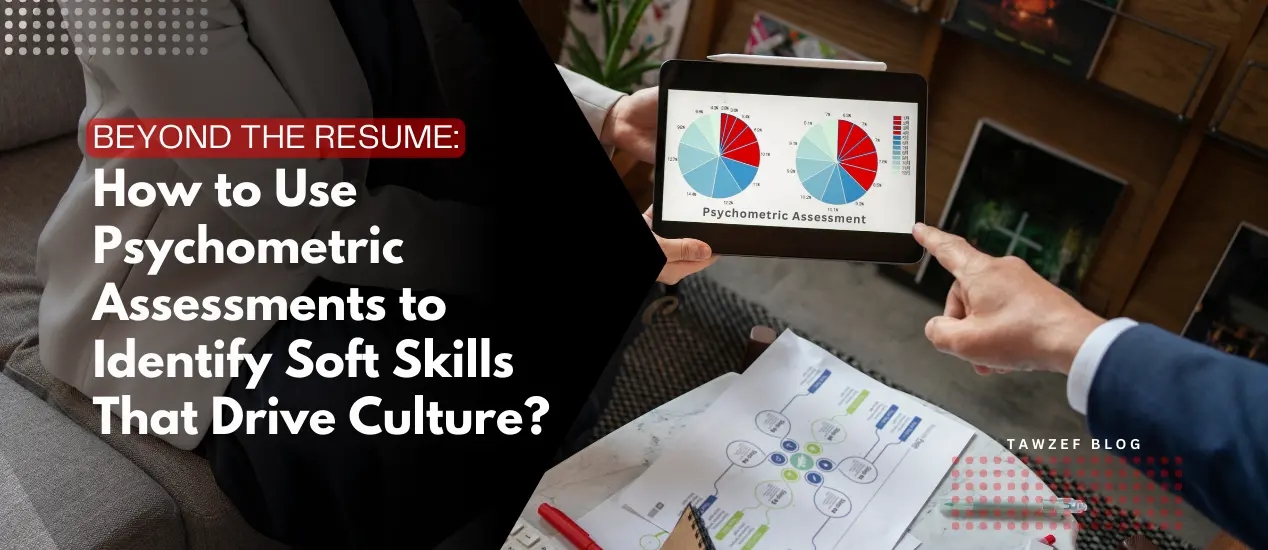


Resumes remain a critical part of the modern recruitment process. However, managers realize that while a resume shows what a candidate can do, it rarely predicts how they will do it within a team.
Managers know that soft skills, or employability skills, like emotional intelligence (EQ), resilience, and critical thinking, are the real "force multipliers" for long-term performance.
Statistics show that 80% of employee turnover results from poor hiring decisions, often due to traditional interviews not revealing a candidate’s true personality. That’s why 92% of hiring managers value soft skills as much as technical expertise.
This is where psychometric assessments come into play. They reveal these hidden aspects in a candidate’s character. They go beyond the resume and even the 1-on-1 interview.
To bridge this gap, companies are adding psychometric tests to their recruitment strategy, including both internal and external hiring.
In this article, we will focus on how psychometric assessments help managers identify essential soft skills, lower hiring risks, and build stronger, scalable teams.
What Are the Benefits of Psychometric Assessments?
Psychometric assessments offer managers and recruiters a scientific way to measure intangible qualities like cognitive ability, behavioral style, motivation, and emotional intelligence.
These data-driven tools transform the hiring process from a guessing game into a science. By quantifying traits like EQ and resilience, psychometric assessments can improve hiring accuracy by 25%, reduce turnover by 20-30%, and trim the costs of bad hires.
Key benefits include:
Better fit & fewer bad hires: Identify candidates who align with your team, reducing bad hires and mismatches.
Lower turnover: Culturally fit candidates are likely to stay longer, perform better, and grow in the company.
Highlight strengths & needs: Psychometric tests help managers and recruiters understand where candidates excel and where they need support. This can impact a company’s performance management schemes and workforce planning initiatives.
Identify leadership potential: These types of tests help companies uncover decision-makers and identify leadership potential early on.
Data over instinct: They allow the use of structured data instead of relying on gut feelings or biases.
Reduced bias: Standardized assessments minimize human bias.
Time efficiency: Quickly identify top candidates, saving time and costs.
EQ measurement: Helps gauge how candidates will collaborate and fit into your team and culture.
Types of Psychometric Assessments
There are several types of psychometric assessments. Each is designed to reveal soft skills that won’t be evident on an applicant’s resume. They include:
Cognitive ability tests:
They evaluate numerical, verbal, and logical reasoning skills. They indicate how quickly candidates can process information, solve problems, and adapt to complex situations. These factors are critical indicators of learning agility and readiness for specific roles like software development, data analysis, and tech lead roles, among others.
Personality questionnaires:
These examine work style, communication preferences, and behavioral tendencies. They help organizations understand cultural fit, collaboration patterns, and potential leadership qualities.
Situational judgment tests (SJTs):
SJTs place candidates in realistic workplace scenarios to assess their decision-making abilities, emotional intelligence, and ethical judgment. They provide insights into how individuals are likely to behave on the job, compared to what they claim they would do.
What Soft Skills Can Psychometric Tests Help You Uncover?
Psychometric assessments help managers identify essential soft skills that are often overlooked in CVs and hard to validate through interviews.
By using one or more of the abovementioned tests, managers gain insights into how candidates think, interact, and respond under pressure.
Common soft skills psychometric tests can help you uncover:
Emotional intelligence
Adaptability & learning agility
Critical thinking & problem-solving
Decision-making skills
Communication
Culture alignment and fit (value-fit)
Resilience and stress tolerance (not physical)
Ownership & accountability
Collaboration & teamwork
Leadership potential
Instead of relying on intuition about "culture fit," managers can leverage assessment data to understand a candidate's potential performance within a team.
Psychometric Tests, Skills, and Scaling Culture
Managers don't need "nice people." They need individuals who can think clearly, excel under pressure, and adapt without constant supervision.
Psychometric assessments help managers identify these traits early, before performance issues arise during reviews or cause team conflicts.
Critical thinking and problem solving
These assessments reveal whether a candidate can connect the dots and make sound decisions when situations change, rather than relying on step-by-step instructions.
For managers, this directly translates into fewer escalations, enhanced project management, and problem-solving skills.
For example, a tech manager might use a logical reasoning test to assess whether a lead developer can pivot effectively during a live server incident. The psychometric test doesn’t measure technical competence, but the ability to think clearly and act decisively under pressure.
Emotional intelligence
EQ assessments reveal how a candidate manages their own emotions and navigates team dynamics when pressure or conflict arises.
For managers, high-EQ employees mean fewer interpersonal issues, less micromanagement, and faster conflict resolution.
Teams with high emotional intelligence can achieve up to a70% improvement in organizational performance through stronger collaboration and quicker decision-making.
Adaptability and resilience
Adaptability assessments show how well a candidate handles change, ambiguity, and independent decision-making.
For managers, this matters because adaptable employees don’t stall or panic when priorities shift. They recalibrate and keep moving.
This trait is critical in hybrid and remote environments, where self-regulation, ownership, and the ability to operate without constant oversight directly determine performance.
How to Use Psychometric Assessments for Recruitment & Selection?
Understanding the different types of psychometric tests and what they accomplish is the first step. Next is effectively integrating them into your hiring workflow.
Top-of-funnel screening
Integrate psychometric tests in your hiring process using short aptitude tests at the start of the hiring funnel.
This helps you to quickly narrow down large applicant pools to identify high-potential candidates. Assessment results can then guide more in-depth and targeted interviews.
Deep-dive interviews
Integrating psychometric assessments into deep-dive interviews means shifting the conversation from hypothetical scenarios to the candidate's actual behavioral data.
Instead of asking generic questions, you use the assessment report to probe "blind spots" or verify high-scoring strengths.
This turns the interview into a validation session rather than a discovery session.
Use case: Toxic leadership vs psychometric testing
A sales director may appear impressive on paper, demonstrating strong performance metrics. Yet, when hired, they end up harming team morale with a toxic leadership style.
A behavioral assessment would have shown low scores in agreeableness and empathy, predicting a high turnover rate within that sales director’s team or department.
The key takeaway for managers? Psychometric assessments indicate that culture fit is not just an instinct or a subjective assessment, but a measurable data point that can help prevent costly hiring mistakes before they negatively affect performance.
Global Case Studies of Companies Using Psychometric Testing in Recruitment
Several companies around the world have used these tests in various stages of recruitment and selection. Two popular examples include Google and Unilever.
Google: Scaling hiring with data
Google used psychometric and cognitive assessments to sift through large applicant pools. Doing so helped Google enhance role alignment, reduce turnover by up to 15%, and increase employee satisfaction by 20%.
Unilever: Gamifying candidate engagement
Meanwhile, Unilever turned to a gamified assessment model, allowing it to double candidate engagement and increase the diversity of its global applicant pool.
Building Your 2026 Talent Strategy with Tawzef
Psychometric assessments act as a hiring compass. They don’t just help you choose the right employees, but particularly those who will resonate with your organization.
This allows for better employee retention, career growth within the company, and enhanced operations.
As organizations scale into 2026, successful talent strategies will confidently move beyond traditional resumes and interviews.
Embracing data-driven hiring practices is becoming essential, allowing managers to understand how individuals think, behave, and perform under pressure.
Psychometric assessments equip leaders with a powerful tool to pinpoint critical soft skills, significantly reduce hiring risks, and build high-performing teams that fit the company’s culture.
At Tawzef, we provide a unique advantage with our localized psychometric assessments tailored specifically for the Middle Eastern market.
We empower managers to hire not just for technical skills but also for mindset, motivation, and cultural alignment.
Don't leave your next hire to chance. Partner with Tawzef today and implement a customized psychometric assessment suite that enables your managers to make smarter, faster, and more confident hiring decisions.